Commercial and non-domestic premises
Offices, shops, places of worship and other non-domestic premises, assessed to PAS 79-1:2020 under the Regulatory Reform (Fire Safety) Order 2005, with a prioritised, plain-English action plan.



If you are the responsible person for a building, the law requires a suitable and sufficient fire risk assessment, recorded in full and kept under review. We assess single buildings and whole portfolios to PAS 79-1:2020 for non-housing premises and BS 9792:2025 for housing, with a prioritised, plain-English action plan.
Government guidance for purpose-built blocks of flats sets out four types of fire risk assessment, defined by how far the inspection goes and whether construction is opened up. The right type controls both the cost and what the assessment can tell you.
The basic assessment required to satisfy the Fire Safety Order, and normally sufficient for most purpose-built blocks unless there is reason to expect serious deficiencies.
Types 2 and 4 open up construction on a sampling basis, usually with a contractor to make good, and are only appropriate where there is good reason.
Types 3 and 4 extend into a sample of flats, beyond the scope of the Fire Safety Order. They are not normally possible in long leasehold flats, where the freeholder usually has no right of access.
Not sure which type you need? Send us the address, height and number of flats, with the date of the last assessment. We will recommend the right type and confirm a fixed fee.
Request a fire risk assessment quoteType 1: common parts only, non-destructive. The basic assessment required to satisfy the Fire Safety Order. We inspect the common parts and a sample of flat entrance doors, lifting ceiling tiles and opening service risers on a sample basis where practicable. Flats are not entered beyond the entrance door.
Type 2: common parts only, destructive. As Type 1, with construction opened up on a sampling basis, usually by a contractor who makes good afterwards. Usually a one-off, carried out only where there is good reason to suspect serious structural deficiencies that could let fire spread. The age of a block alone is not generally enough.
Type 3: common parts and flats, non-destructive. As Type 1, plus means of escape and fire detection within a sample of flats. This goes beyond the Fire Safety Order, and can suit rented flats where there is reason to suspect serious risk to residents from a fire in their own flat.
Type 4: common parts and flats, destructive. As Type 3, with opening up on a sampling basis in both the common parts and the flats, often only in vacant flats. The most comprehensive assessment, appropriate only in limited circumstances, such as a new landlord taking on a block where the history of works is unknown.
Schematic section, not to scale. Types as set out in the government guide Fire safety in purpose-built blocks of flats, which is being revised.
A single point of contact from first enquiry to final report, with the right specialists on every job.
Address, use, height and number of storeys, number of flats or units, and the date of the last assessment.
The right type of assessment agreed up front, with a fixed fee and insurance certificates on request.
A thorough inspection of the premises. In blocks of flats, the common parts and a sample of flat entrance doors, going into flats or opening up only where agreed.
The assessment recorded in full with the assessor named, and actions prioritised in plain English.
Help closing out actions, liaison with the fire and rescue service where needed, and a review date that keeps the assessment current.
Specialist support for non-domestic premises, and for the bigger questions an assessment can raise about a building.
Offices, shops, places of worship and other non-domestic premises, assessed to PAS 79-1:2020 under the Regulatory Reform (Fire Safety) Order 2005, with a prioritised, plain-English action plan.
Compartmentation surveys, external wall fire risk appraisals to PAS 9980:2022 and EWS1 assessments for existing residential buildings, with remediation advice that is proportionate to the risk.
Support with enforcement notices, prohibition notices and Fire Authority consultation, including waking watch review, fire alarm justification to BS 5839-1:2025 and BS 5839-6, and technical responses that protect your position.
The government's fire risk assessment guides, published under Article 50 of the Fire Safety Order and now overseen by the Ministry of Housing, Communities and Local Government, together with the LACORS guide for existing housing, including HMOs.
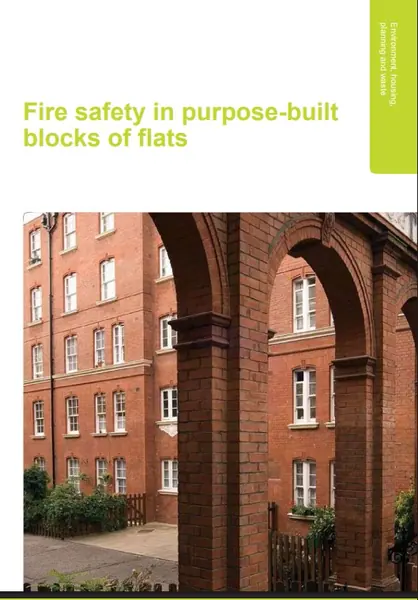 Purpose-built blocks of flatsRead on GOV.UK (opens in a new tab)
 Small blocks of flatsRead on GOV.UK (opens in a new tab)
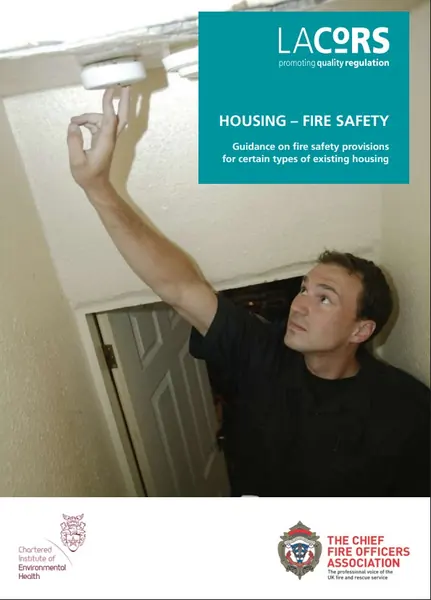 Housing: fire safety (LACORS)Read the guide (opens in a new tab)
 Sleeping accommodationRead on GOV.UK (opens in a new tab)
 Means of escape for disabled peopleRead on GOV.UK (opens in a new tab)
 Offices and shopsRead on GOV.UK (opens in a new tab)
Every assessment is led by an assessor on the National Fire Risk Assessor Register at Advanced Level, and backed by professional indemnity and public liability insurance.
Verify on the NFRAR registerSend us the address, height and number of flats, with the date of the last assessment. We will recommend the right type and confirm a fixed fee.